


Get peace of mind with at-home STI testing
STI testing for men and people with penises
Test for 6 sexually transmitted infections from the privacy of home. Protect your sexual and fertility health, get prepared for fertility treatments or trying to conceive, and prevent the spread of infection to others.
Frozen in under a week
Free overight shipping
CLIA-certified lab
Is STI testing covered by insurance?
At-home testing for 6 STIs
For men and other people with penises, STIs are more likely to have no symptoms at all. That means you may not know you have one — unless you test.
Chlamydia is a common STI caused by bacteria. Some people with chlamydia will experience pain in their genitals or discharge, but many will have no symptoms.
Chlamydia is easily treated with antibiotics. If chlamydia is left untreated, it could affect a person’s fertility or spread to a partner.
Chlamydia is easily treated with antibiotics. If chlamydia is left untreated, it could affect a person’s fertility or spread to a partner.
Gonorrhea is a common STI caused by bacteria. Some people with gonorrhea will experience pain while urinating or discharge, but many will have no symptoms.
Gonorrhea is easily treated with antibiotics. If gonorrhea is left untreated, it could affect a person’s fertility or spread to a partner.
Gonorrhea is easily treated with antibiotics. If gonorrhea is left untreated, it could affect a person’s fertility or spread to a partner.
Hepatitis B is a virus that can spread via sex, and can cause liver infection and inflammation. Some people with hep B will have abdominal pain, fever, or fatigue, but many will have no symptoms.
Hepatitis B can’t be cured with antibiotics, but about 95% of people infected with the virus will recover on their own in 4–8 weeks. In rare cases, people can become hep B “carriers,” with long-term contagious infections.
Hepatitis B can’t be cured with antibiotics, but about 95% of people infected with the virus will recover on their own in 4–8 weeks. In rare cases, people can become hep B “carriers,” with long-term contagious infections.
Sperm concentration is the number of sperm per milliliter of semen. This number helps us compare your sample to others.
A hepatitis C antibody test will tell you if you’ve ever had a hep C infection. If you test positive, you’ll need an additional test to measure the amount of hepatitis C virus in your blood. Hepatitis C can typically be treated with antiviral medications. If hep C is left untreated, it can cause damage to the liver or spread to other people.
A hepatitis C antibody test will tell you if you’ve ever had a hep C infection. If you test positive, you’ll need an additional test to measure the amount of hepatitis C virus in your blood. Hepatitis C can typically be treated with antiviral medications. If hep C is left untreated, it can cause damage to the liver or spread to other people.
HIV (human immunodeficiency virus) is a virus that can spread via sex. Some people with HIV will have temporary flu-like symptoms, while others will have no symptoms.
HIV affects the immune system and can reduce a person’s ability to fight off infections. HIV can’t be cured with antibiotics, but antiviral medication can reduce symptoms and the chance of spreading HIV. If HIV is left untreated, it could develop into AIDS, a disease of the immune system.
HIV affects the immune system and can reduce a person’s ability to fight off infections. HIV can’t be cured with antibiotics, but antiviral medication can reduce symptoms and the chance of spreading HIV. If HIV is left untreated, it could develop into AIDS, a disease of the immune system.
Syphilis is a common STI caused by bacteria. Some people with syphilis will experience genital sores, but some will have no symptoms.
Syphilis is easily treated with antibiotics. If syphilis is left untreated, it could affect a person’s fertility, spread to a partner, or have wide-ranging impacts on the body and brain.
Syphilis is easily treated with antibiotics. If syphilis is left untreated, it could affect a person’s fertility, spread to a partner, or have wide-ranging impacts on the body and brain.
We’re the only at-home sperm testing and freezing service that offers at-home STI testing and sperm DNA fragmentation analysis.
How it works
01
02

03
04
Products that include STI testing:
5-year sperm freezing plan
Best for:
- Pre-vasectomy
- Military deployment
- Before testosterone therapy

Most popular
For Tomorrow bundle
$1,495
Sale price
Includes:
5 years of storage (renewable)
2 collection kits for 2 samples
Does not include Advanced Semen Analysis with DNA fragmentation testing
25-year sperm freezing plan
Best for:
- Before medical treatment
- Pre-gender transition
- Long-term planning
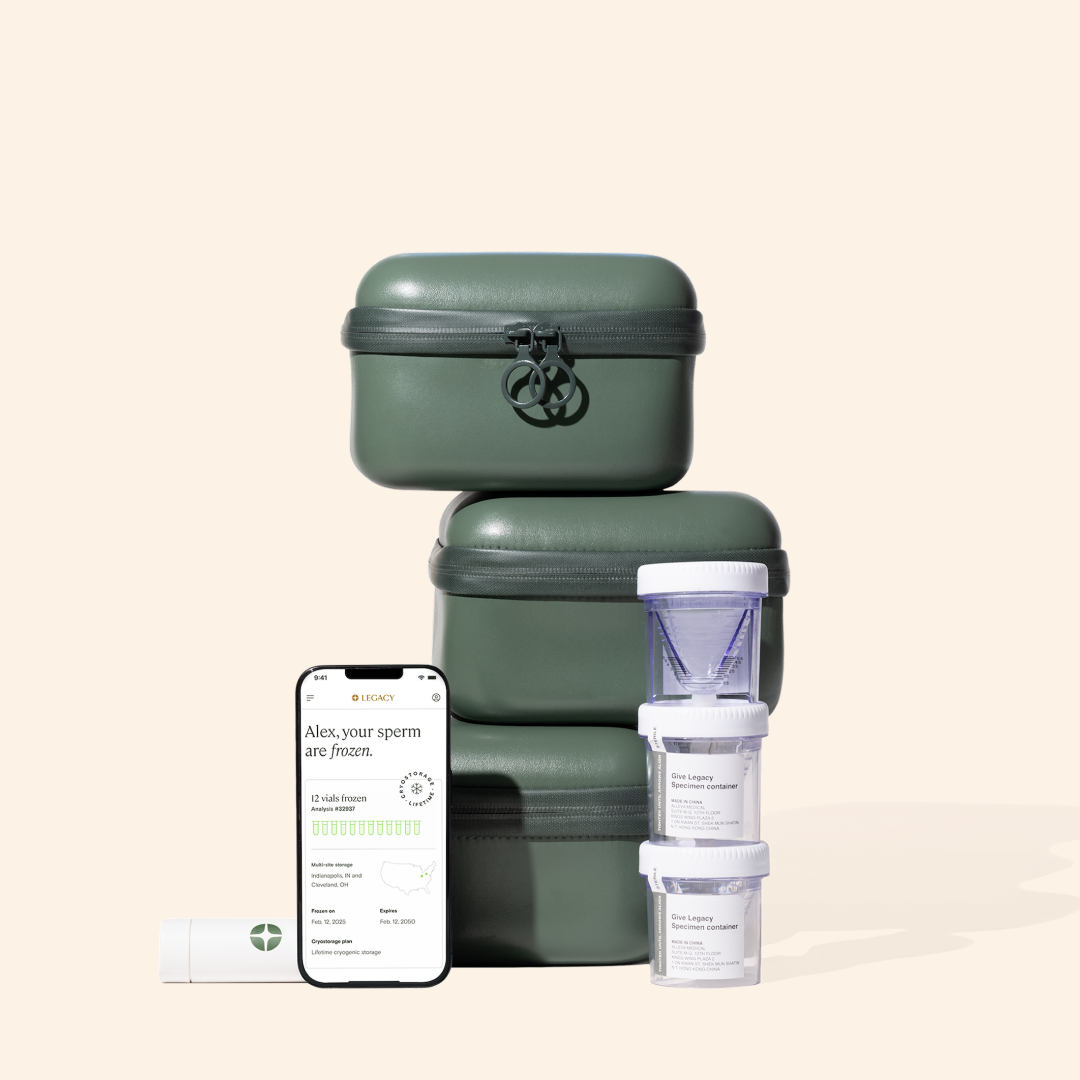
Most popular
Forever bundle
$4,995
Sale price
Includes:
25 years of storage
3 collection kits for 3 samples
Advanced Semen Analysis with DNA fragmentation testing
Frequently asked questions
What is a sexually transmitted infection (STI)?
What’s the difference between an STI and a STD?
What is STI testing?
When should I get tested for STIs/STDs?
How is STD testing done?
Is STI testing covered by insurance?
What if my test has a positive result for one or more STIs?
Is it necessary to get tested for STIs before freezing my sperm?
Do I perform my STI test before or after sperm analysis?
If I test positive for one or more STIs, can I still freeze my sperm?
Will I be charged more for sperm freezing if I test positive for an STI?
If I test positive for one or more STIs, can I still use my sperm for IUI or IVF?
If I test positive for an STI, can Legacy offer me treatment?
Can I meet with a Legacy provider to review my STI testing results?
If I'm freezing more than one sample, do I need to do STI testing again?